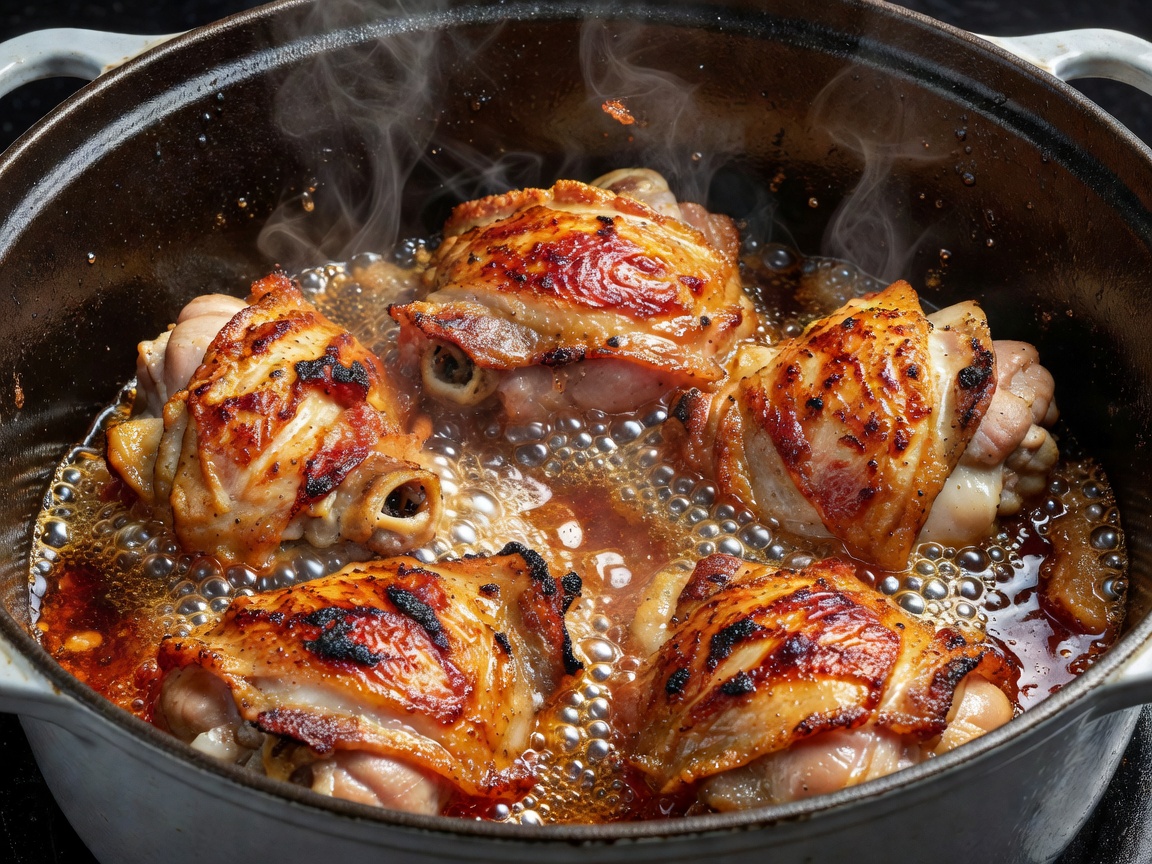
Stage 1: Rendering Lardons into Liquid Gold
Before any poultry touches the pot, your Dutch oven must be prepared with the proper cooking medium. Place your sliced pork lardons into an unheated enameled cast-iron braiser with one tablespoon of cold water. As the water comes to a gentle simmer, it draws out the pork fat without allowing the exterior proteins to scorch.
Once the water boils off, lower the burner heat to medium-low. Cook the lardons for eight to ten minutes until crisp on all sides and surrounded by three to four tablespoons of clear, liquid rendered lard. Using a slotted spoon, lift the lardons onto a paper-towel-lined plate and reserve them for the final garnish. Leave all rendered pork fat in the pot.
Stage 2: The High-Heat Batch Sear (The Maillard Foundation)
Browning meat is often misunderstood as "sealing in juices." Scientifically, searing does not create an impermeable barrier to moisture; rather, it triggers the Maillard reaction—a chemical reaction between amino acids and reducing sugars occurring above 140°C (284°F) that creates hundreds of complex, savory flavor molecules.
Avoid Pan Crowding at All Costs
When cold poultry is packed tightly together into a pot, ambient moisture escaping from the meat cannot evaporate instantly. Instead of frying in hot fat, the chicken ends up stewing in pooled water at 100°C (212°F), resulting in flabby gray skin and zero fond formation. Always sear in batches of two to three pieces at a time.
Ensure each chicken cut has been dried aggressively with paper towels. Season generously with fine sea salt. Increase heat under the braiser to medium-high until the pork fat begins to ripple.
- Lay poultry skin-side down into the hot fat without moving it for five minutes.
- Do not force the meat if it sticks; as proteins caramelize and shrink, the meat releases naturally from the enameled surface.
- Flip and brown the reverse side for three to four minutes.
- Transfer browned poultry to a resting plate. The bottom of your pot will now be covered with a deep reddish-brown glaze known in French culinary terms as le fond.
Stage 3: Sautéing Aromatics & The Cognac Flambé
Reduce heat to medium. Add your drained marinade vegetables (sliced carrots, quartered onions, and crushed garlic). Sauté them in the remaining rendered fat for five to six minutes until the edges take on a golden brown hue.
Optional but traditional: add 60ml (1/4 cup) of French Cognac or aged grape brandy. Step back and carefully tilt the pot toward a gas flame or use a long match to ignite the alcohol vapor. The intense localized heat burns off raw ethanol instantly while caramelizing the sugars in the spirit, imparting a warm, oaky backbone to the aromatics.
Stage 4: Deglazing the Pot and Oven Braising
Now comes the pivotal moment where fond turns into sauce base. Pour 250ml of your reserved wine marinade directly into the hot pot. It will boil violently. Immediately use a flat wooden spoon to scrape the bottom vigorously, freeing every microscopic fragment of caramelized chicken and pork residue from the enamel.
Add the remainder of the wine, along with 250ml of rich, unsalted dark chicken or veal stock and one tablespoon of concentrated tomato paste. Return the chicken pieces, nestling them down into the liquid so they are submerged by approximately two-thirds. Tuck your bouquet garni in the center.
| Braising Method | Thermal Range | Duration | Advantages / Cautions |
|---|---|---|---|
| Stovetop Simmer | 95°C – 102°C | 60–75 Min | Direct bottom heat can scorch bottom solids if not watched constantly. |
| Oven Braise (Ideal) | 155°C – 160°C (310°F) | 75–90 Min | Surrounding ambient 360-degree radiant heat prevents boiling hot spots. |
| Slow Cooker / Crock | 80°C – 88°C | 4–5 Hours | Fails to evaporate wine volatiles; leaves sauce watery and acidic. |
Cover with the heavy lid, leaving a crack of 2mm open to allow gentle evaporation, and place in a preheated 160°C (320°F) oven. Check after twenty minutes: the braising liquid should display a gentle, lazy bubble every few seconds. If it is rolling violently, drop the oven temperature by 10 degrees.