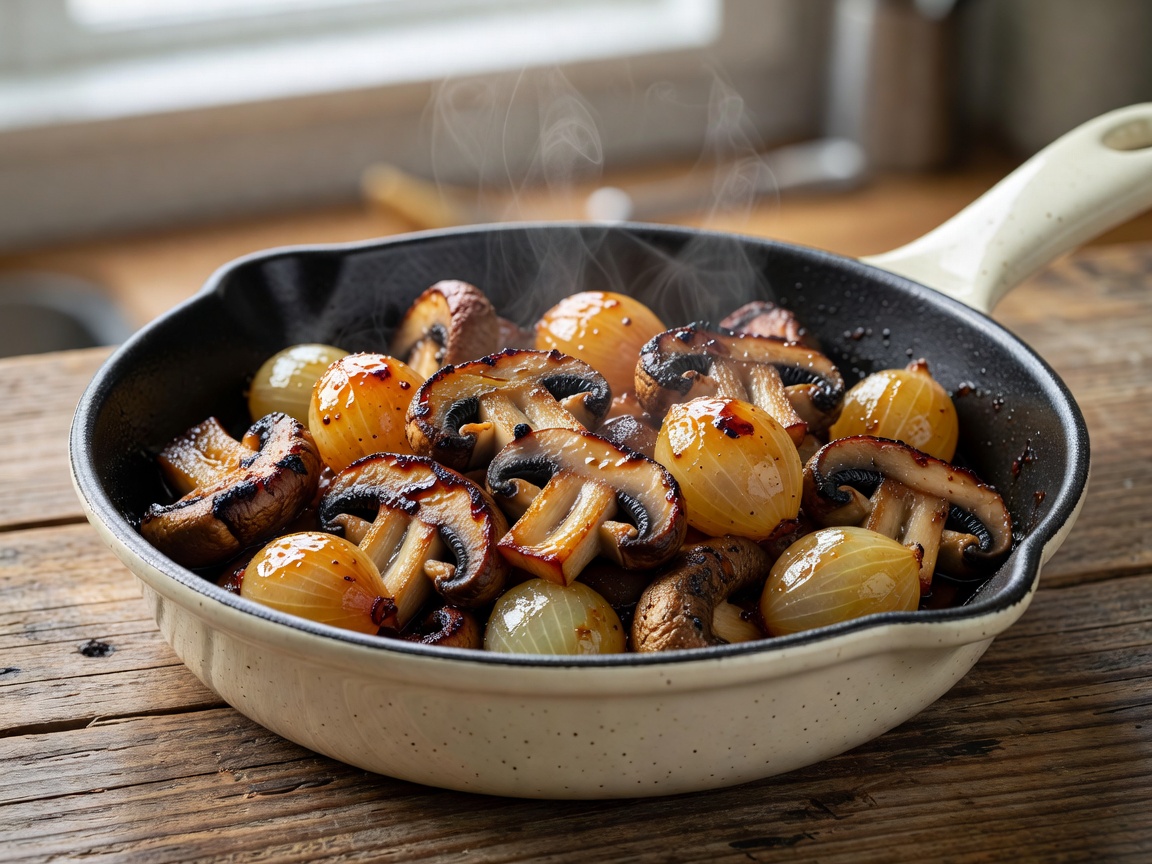
The Common Error: The "One-Pot" Trap
Home cooks frequently toss whole mushrooms and raw pearl onions straight into the main braising pot with the chicken, assuming that simmering everything together builds better cohesion. In practice, this ruins both ingredients:
- Spongy Mushrooms: Mushrooms act like dense organic sponges. Simmered for an hour and a half in wine broth, their cell walls collapse into waterlogged rubber cushions dyed dark indigo.
- Dissolved Onions: Pearl onions disintegrate into pulpy shreds, clouding the liquid and stripping the plate of distinct visual contrast.
In classical French brigade kitchens, the garniture—the lardons, mushrooms, and pearl onions—is prepared entirely on the side in separate sauté pans and folded into the silky wine sauce just minutes before serving. This ensures every bite provides contrasting textures: chewy-crisp cured pork, sweet tender onion bulbs, and toothsome, browned mushrooms.
Technique 1: Glazing Pearl Onions (Oignons Glacés à Brun)
Peeling twenty tiny pearl onions by hand can test any cook’s patience. The classic solution is thermal shock:
- Thermal Blanch: Drop whole unpeeled pearl onions into a pot of boiling water for sixty seconds.
- Ice Shock: Transfer them immediately with a spider strainer into a bowl of ice water.
- Slip the Skins: Slice off the tiny root tip with a paring knife and gently pinch the stem end; the onion bulb will slip cleanly from its papery jacket.
Once peeled, place the onions in a single layer in a wide skillet. Add just enough cold water (or light chicken broth) to reach halfway up the sides of the onions (about 120ml). Add 15g (1 tablespoon) of unsalted butter, a half-teaspoon of granulated sugar, and a pinch of salt.
Place over medium heat. As the water simmers away, the onions cook through to their centers. Once the liquid evaporates completely, the remaining butter and melted sugar will begin to fry the onions. Swirl the skillet continuously until each onion bulb is coated in a glistening, mahogany-brown caramel glaze. Remove from heat and set aside.
The Sugar Chemistry
The addition of sugar is not to make the dish sweet; it accelerates caramelization before the onions turn to mush, neutralizing the sharp sulfurous bite of the allium and replacing it with a mellow, buttery sweetness that buffers the dry acidity of the reduced red wine.
Technique 2: High-Heat Pan-Roasting of Cremini Mushrooms
For optimal earthiness, select firm brown cremini (baby bella) mushrooms, or a mix of chanterelles and king oysters.
Do not wash mushrooms under running tap water; wipe them cleanly with a damp kitchen cloth to avoid excess moisture. Quarter small mushrooms, or halve them if diminutive, ensuring pieces remain bite-sized and structurally distinct.
| Cooking Factor | Traditional Method (Correct) | Home-Cook Shortcut (Faulty) |
|---|---|---|
| Heat Setting | High / Med-High with clarified butter | Low simmer in sauce |
| Pan Crowding | Single layer, 1cm space between pieces | Piled three layers deep |
| Texture Result | Golden crisp exterior, fleshy firm core | Mushy, wet, and squishy |
| Flavor Impact | Nutty umami enhancement | Dilutes sauce with excess released water |
Melt two tablespoons of butter with a splash of high-smoke-point oil in a heavy stainless steel or cast-iron skillet over medium-high heat. Add the mushrooms in a single layer. Resist the urge to shake or stir the pan for the first three minutes. Let the mushrooms release their initial water, evaporate it, and sear against the pan until a deep golden-brown crust forms.
Toss them once or twice, season with fine salt, freshly ground black pepper, and a teaspoon of freshly chopped thyme leaves. Sauté for another two minutes, then remove from heat.
Holding and Marriage
Your three garnish elements—the crispy lardons, the glazed pearl onions, and the browned mushrooms—now sit ready at room temperature. They will not re-enter the cooking process until the chicken has completed its braise and the wine sauce has been strained and reduced to its final, velvet consistency.